 CargoPlan OKcpok.com
How many pallets fit in a 40 ft container?
Short answer: 20 American pallets, 25 European pallets, and no, not 21. Longer answer below, with floor plans.
Ask five freight people and you’ll get four numbers, all defensible, none quite right for your load. That’s because “how many pallets fit” is not one question. It is a footprint question, then a height question, then a weight question — and most quotes stop after the first one.
| Pallet | Footprint | 20 ft | 40 ft (GP or HQ) | 45 ft HQ |
|---|---|---|---|---|
| GMA (US) | 48 × 40 in | 9 | 20 | 24 |
| Euro (EPAL) | 1200 × 800 mm | 11 | 25 | 27 |
| Euro 2 | 1200 × 1000 mm | 9 | 22 | 24 |
| Asia | 1100 × 1100 mm | 10 | 20 | 24 |
| Australia | 1165 × 1165 mm | 10 | 20 | 22 |
Twenty and twenty-five are the numbers that survive contact with a floor plan. The rest of this page is why, and what changes them.
01 Why Europe gets 25 and America gets 20
A 40 ft container gives you 474 inches length and 92.5 inches width. That is the whole board. Everything else is how you lay rectangles on it.
GMA pallets are 48 × 40. Turn them so the 48 runs along the box: nine fit down the length (432 inches) and two rows fit across the width (80 inches). That’s 18 pallets and a 42-inch strip left over at the end. A turned pallet needs 40 of those 42 inches, so one more goes in: 19. Now start with the pallets turned the other way — eleven down the length at 40 inches each, one row of 48 across — and the remaining 44 inches of width takes nine more straight. Twenty. The geometry gives 20, and the 19 is what you get if you fill the obvious rows first and then look at the leftovers.
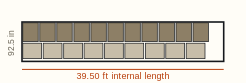
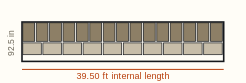
Euro pallets are 1200 × 800 — narrower by a third. One row of 800 across plus one row of 1200 across uses 78.7 of the 92.5 inches available, and that combination packs 25 on the same floor: fifteen turned down the length, ten straight. Same box, same skill, five more pallets, because the pallet is smaller.
02 The 21st pallet is usually a counting error
You will see 21 quoted for GMA pallets in a 40 ft, often by brokers and occasionally by carriers. The arithmetic doesn’t support it. The floor is 92.5 inches wide. Two rows of 48-inch pallets need 96. There is no orientation of a 48 × 40 rectangle that adds a 21st pallet without overhanging the floor or the doors.
What does happen: someone measures the container at its external width, or counts a pallet that sticks two inches into the door opening, or plans a hand-built pattern the loader then refuses. Overhang is the first thing an inspector looks for, and it is grounds for re-class or rejection. Plan 20.
03 Height decides the second tier
Forty-foot standard and high cube share the same floor; the high cube just adds 11.7 inches of height. Whether you get a second tier comes down to one division: usable height minus clearance, divided by loaded pallet height.
A high cube has 105.6 inches inside and 101.3 at the door. Two tiers need each load to finish at 52.8 inches or less, including the pallet. Most loads finish at 55 to 65. That means one tier, 20 pallets, and roughly half the box empty above them. This is the moment to ask whether a 40 ft is the right box — a 20 ft holds 9, so if you have 14 pallets you are paying for a container you don’t fill, and a shared LTL move may beat it.
04 Weight usually gets there first
A 40 ft high cube carries about 58,000 lb. Divide that by 20 pallets and you get 2,900 lb per pallet. Anything heavier — drums, densified scrap, wet goods, tile — hits the payload before it hits the ceiling. The count on this page is a floor count. Your bill of lading is a weight document.
Two consequences worth stating plainly: a half-loaded container of heavy freight is normal and not a mistake, and a full container of light freight is expensive because you are shipping air. Density is the number that tells you which one you have — that’s the density tool.
05 What to send your forwarder
Five numbers get you an accurate quote and a load plan that survives the dock:
- Pallet footprint, including any overhang, in inches or millimetres.
- Loaded height, to the top of the goods, plus the pallet.
- Weight per pallet, not just the total.
- Whether it stacks — and whether the bottom pallet can take the top one.
- Anything that won’t clear a 89.5-inch door upright.
Send those and you will get a real answer in one exchange instead of three. Or run them through the container planner and send the diagram; people argue with numbers far more readily than with a floor plan.